Your shopping cart

Wünsch dir deinen Black Deal: persönliches Angebot bis Dienstag anfragen | Jetzt anfragen
Camera Basics Open Gate and its advantages explained
Reading time: 5 minutes - February 28, 2024 - by Markus Igel

Camera Basic #20 - Open Gate and its advantages for social media explained

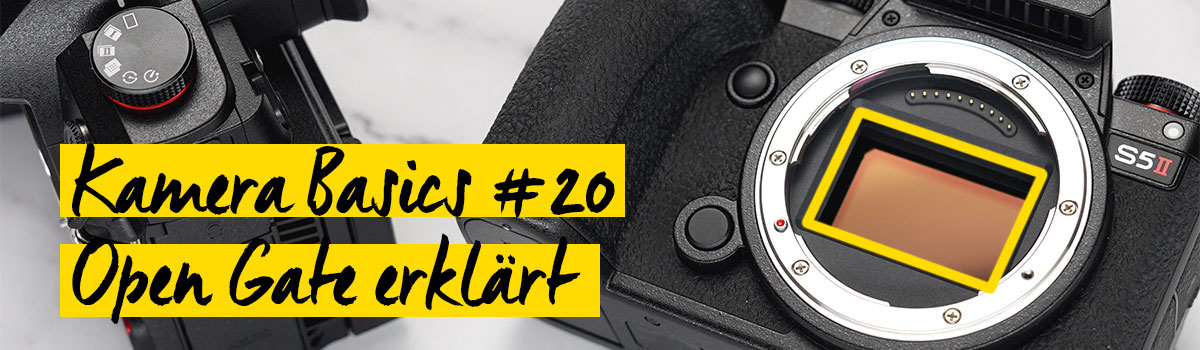
Social media has become indispensable and the technology continues to develop. Open Gate technology offers the possibility to read out the full sensor for video, because most cameras crop the image section to 16:9 when filming, which is okay for YouTube, but if you are filming productions for fashion campaigns, for example, where you need video material in portrait and landscape format, portrait format is required.

Open Gate reduces the production effort because you no longer have to make two separate recordings or crop the image with a loss of image quality.

We look forward to your feedback on this article! Just send us an e-mail to [s-t-r-o-n-g]content@fotokoch.sk[e-n-d-s-t-r-o-n-g]

The sensor format plays a role with Open Gate

The MFT sensor really comes into its own for social media. When filming with this sensor format in Open Gate, you almost have a square, which means that the image can be cropped with less loss on the sides.

MFT Open Gate aspect ratiosMFT Open Gate aspect ratios

With full format, the 16:9 image section looks different again and you lose more pixels on the long side of the horizontal image of the full format sensor.

APS-C and full-frame open gate aspect ratiosAPS-C and full frame open gate aspect ratios

Maximum flexibility when trimming

If you film with a camera with 6K OpenGate, you can crop many different image formats in the post-production of the video and thus meet different customer requirements, all with just one video recording and less image material. This shortens the shooting day and increases productivity.

Whether 16:9, 1:1, vertical 9:16 with 6K OpenGate, you don't need multiple camera settings to make all this possible.

So far, the Panasonic brand has offered the full-frame solution here and those who like to use APS-C will also find the Open Gate on some models.

Maximum flexibility of the 6K Open GateMaximum flexibility of the 6K Open Gate

History of the "open gate"

Of course, our system cameras don't have open gates, as was once the case with analog film, where there was a person on set who checked the camera's film gate for hair and dust and removed it before the next take. In general, open gate should rather be called "full sensor recording", but there is no suitable term like the gate from analog photography for digital photography.

A practical feature

Another practical feature is that some cameras, such as the Panasonic S5II +amp; Co, allow you to set subframes that show you whether your subject is in the export formats in the image when filming, allowing you to set 9:16, 1:1 or 5:4, for example, and produce the content quickly and effectively.

Conclusion

The OpenGate offers many advantages and essentially no disadvantages for videographers. The only disadvantage with the current cameras available on the market (02.2024) is that no more than 30fps is possible in the OpenGate. This makes it particularly suitable for interviews and small showcases without slow-motion scenes.

A little task for you:

Have a look at your camera's setting options and see what the largest possible format of your camera is!

Show us your pictures on Instagram and/or Facebook and tag us @fotokochde! We look forward to seeing your results!


Thank you for reading this article. If you're interested in other photography basics, then take a look at the other camera basics

Get to know your camera ? Discover the fun of photography

Have you bought a camera and are taking your first steps in photography? You're missing out on a lot of potential with automatic mode! Photography is only really fun when you understand your camera and know exactly which settings to use to get the photo you want. Get to know the importance of the functions and ignite your enthusiasm for photography

To all camera basics

More articles about getting started in photography

Guide for bird photography

Great shots of birds are no longer a secret thanks to our guide! Take advantage of autumn and our tips to capture fantastic shots of birds this weekend.

Read now

Camera Basics #24 - What are video codecs?

This time, the topic of video codecs is aimed at videographers, or those who want to become one. Photographers are less likely to be able to use them, but extra knowledge rarely hurts. We explain how video codecs work and what they are used for. Video codecs are very complex, which is why we will go into many facets here and also how you can improve or worsen your video editing performance by using different codecs.

learn more

Camera Basic #23 - What is dynamic range?

Modern camera sensors contain a lot of image information, which can be used to your advantage when shooting in RAW format. The extent to which this image information can be exploited depends entirely on the ISO you use, as this greatly changes the sensitivity of the sensor.

Inform now

Camera Basics #22 - What are chromatic aberrations?

We have already written so many technical blog articles about the basics of photography and videography, but we have not yet talked about one of the most well-known optical errors (aberrations), chromatic aberrations.

Read now

Camera Basics #21: Getting started with sports photography

We confidently say that this article is one of the best ever for sports photography. In the guide, we also try to cover the various equipment decisions and how to find the perfect settings.

Read now

Camera Basic #03 - What is ISO sensitivity?

ISO is one of the core elements of photography. If you understand ISO, you can work much better with the light in many situations and can also use ISO noise as a stylistic device for your photos.

Read now

Camera Basics #19: Tilt shift lenses and the effect explained

The tilt shift effect is certainly an old shoe for many photographers, but this effect is very interesting to consider because it can be found in many facets of photography, so the use of tilt shift optics is not only at home in architectural photography.

Read now

Camera Basics #18: Megapixel explained

Everyone needs 100 megapixels! Or do they? Many photographers or smartphone owners always have discussions about megapixels. That's why we explain today what consequences megapixels have!

Read now

Interesting campaigns

First test of the Sony 16-35mm f2.8 GM2 compared to the 16-35 GM1

The new Sony 16-35mm GM2 is here and sets new standards! It is lighter, sharper and even more compact than its predecessor! Therefore, we show you today the direct comparison of the two G-Master lenses and show whether an upgrade is worth it!

Read now

Camera Basics #13: CMOS, BSI sensor or stacked sensor? What are the differences?

As a specialist retailer, we have a mission: we want to give you the best possible advice and help you to better understand the differences between the various technologies available on the camera market. That's why we want to give you an understanding of the different sensor technologies today. In particular, the differences between the stacked sensor and the BSI sensor.

Read now

Camera Basics #12: Getting started with macro photography

Imaging small objects and details in a big way! That already describes macro photography very well! But what exactly could be a motif for this type of photography? Soap bubbles, insects, flowers, snowflakes and much more, that could include the shots as a motif.

learn more

Things to know about deep discharge for camera batteries

Who has ever really dealt with camera batteries and the deep discharge. We have collected some information around the topic for you.

learn more

Last viewed articles

Also interesting

Get Your Photos Ready Quickly—Editing with X-RAW (Peter Fauland)

Want to get the most out of your RAW files without spending hours in front of the computer? In this live workshop, Peter Fauland will show you how to process your images quickly, easily, and with the best possible quality using Fujifilm X RAW Studio.

Watch it again

Photos and Videos Without Image Editing (Peter Fauland)

Why spend a lot of time on post-processing when you can achieve the look you want right in the camera? In this live workshop, Peter Fauland will show you how to use the right camera settings, Fujifilm’s film simulations, and custom adjustments to create stunning photos and videos that look great straight out of the camera.

Watch it again

The vacation is what matters most; the video is just a bonus. Still, you want to end up with footage that you’ll enjoy watching again and again. Chris Kueper shows you how to do this in five simple steps: from planning to camera movement to editing. With as few lenses as possible, minimal gear, and light weight—compact yet powerful. Using the example of a family trip through Portugal from Porto to the Algarve. The video features practical tips that can be put into practice right away. For anyone who wants to film their memories without turning their vacation into a job.